
Introducing No Delay May
This month ALIA encourages you to check in on every file.
Spring has arrived, carrying an opportunity to spring-clean your practice! ALIA is launching No Delay May, an initiative designed to help you check in on every file. The goal is to ensure all files are properly diarized, progressing as intended, and thoroughly documented to capture your advice and your client’s instructions. Throughout No Delay May, ALIA will send tips and tricks to support your efficient practice.
Master File List Challenge
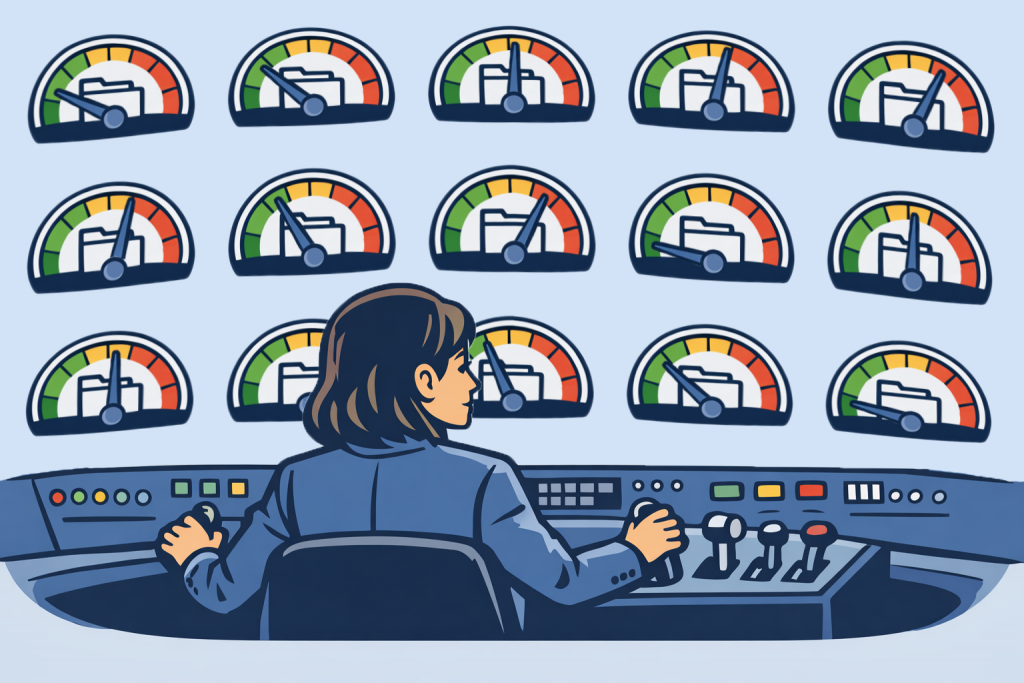
To kick off No Delay May, we challenge you to set up or refresh your Master File List. A well-maintained Master File List is beneficial to lawyers practising in nearly every area of law. Properly used, they facilitate file status reviews at a glance, allowing you to identify next steps, outstanding matters, and approaching deadlines. A Master File List may also help you to manage your overall capacity and workload.

A Master File List should complement your diarization system and offer positive redundancy to ensure your files are progressing and are in order. As you create or refresh your Master File List, be sure to also check that every file is appropriately diarized.
If you are concerned you do not have the time to create a Master File List, consider the return on investment you could realize from the time spent. Setting up a Master File List can yield significant benefits, including enhanced control over your practice, reduced time spent transitioning between files, improved client service, and a lowered risk of communication or delay-related claims.
Resources
For more guidance on Master File Lists, please refer to section 9.5 of Law Practice Essentials (File Management), and Mastering Client Files, which includes links to sample Master File Lists for civil litigation, criminal law, family law, and real estate law. Section 9.3 of Law Practice Essentials also provides an overview on Limitation Dates, Other Deadlines and Diary Systems.
As an Alberta lawyer, you also have access to a wide range of personal and professional services, including practice support from Practice Management, legal and ethical guidance from Practice Advisors, and personal well-being support from Assist, Alberta Lawyers Assistance Society.
Say Nay to Delay in May!
This May, commit time to refreshing your best practices and toolkit. A current Master File List gives you a clear, at-a-glance picture of every matter so you can keep work moving, catch issues early, and prevent delay. Watch for the next No Delay May ALIAdvisory providing practical information around standstill and suspension period agreements.
ALIA does not provide legal advice. ALIAdvisory newsletters, ALIAlert warnings, ALIAction notices, and the content on ALIA’s website, notices, blogs, correspondence, and any other communications are provided only for the general information of members who participate in the indemnity program and do not constitute legal or other professional advice or an opinion of any kind. This information is not a replacement for specific legal advice and does not create a solicitor-client relationship. If you think you would benefit from legal advice, please contact an Alberta lawyer directly.
Links to third-party websites are provided for convenience only; ALIA does not vet or endorse the information contained in linked websites or guarantee its accuracy, timeliness, or fitness for a particular purpose.
Your policy is the contract that specifically and fully describes your coverage, and nothing stated herein revises or amends the policy.
The views and opinions expressed in this article are solely those of the author and do not necessarily reflect the official policy or position of ALIA. If you have any comments on this ALIAdvisory or any suggestions for future ALIAdvisory articles, please contact ALIA.
Demystifying ALIA: What Happens After a Report to ALIA?
You have made a report to ALIA. So… now what?
This article originally appeared in Law Matters, the official publication of the Canadian Bar Association Alberta Branch.
Next steps will vary, depending on the unique circumstances of your reported claim (or potential claim). Regardless of the steps required, the good news is that you are in good hands. Your appointed Claims Counsel will reach out to guide you through the process, will be able to answer any questions you have, and will do their best to ease your mind along the way.
If the claim is potential, perhaps an abundance of caution report, Claims Counsel may simply obtain some additional details from you before placing the file in monitoring mode. In many cases, Claims Counsel will schedule a telephone call with you as a more efficient way of obtaining additional information and context from you regarding the circumstances that may develop into a claim against you in the future. If there is nothing to be done but wait to see whether a claim develops, Claims Counsel will follow up with you occasionally.

Likewise, Subscribers are obligated to report any updates to their assigned Claims Counsel in a timely way. The varying circumstances will dictate how long each potential claim ought to be monitored, before Claims Counsel proceeds with closing the file. Importantly, if a potential claim file is closed and a claim develops thereafter, the file can be re-opened and there is no compromise to your coverage as a result. If no claim ultimately arises, then (generally speaking) no costs or repairs/damages arise, so there is no deductible or surcharge incurred on the file.
On the opposite end of the spectrum, where a covered claim results in litigation, your Claims Counsel will retain defence counsel under a joint retainer. From there, if a waiver of defence can be obtained from plaintiff’s counsel, great, but otherwise defence counsel will ensure your statement of defence is filed straight away and then proceed with a more fulsome assessment of ALIA’s risk and your liability as well as any viable defences. Often, a call between the Subscriber, defence counsel and Claims Counsel will be scheduled at the outset to discuss file strategy including possible early resolution. Strategy calls are typically utilized throughout the litigation’s progression.
Pursuant to the Policy, ALIA has exclusive control of the defence. While a Subscriber’s cooperation is required (document production, questioning, etc.), a Subscriber can request to have as much, or as little, involvement as is possible. Some Subscribers prefer to be closely involved in the litigation strategy, whereas others request high-level updates only. If defence counsel is retained, the $5,000 individual deductible is payable, meaning the Subscriber is responsible for the first $5,000 paid out on the claim. If damages are ultimately paid out on a claim, the surcharge is then payable, which is a professional liability assessment in addition to the annual base levy. The surcharge is payable for five consecutive practice years.
In between those two extremes, you might be faced with a scenario where your former client has made a claim to ALIA, shy of filing/serving a statement of claim. In that case, Claims Counsel will work with you to determine whether the claim has any merit and whether to retain defence counsel or attempt to resolve the claim directly with the former client.
Another unique scenario is where there remains a distinct opportunity for particular steps to be taken to mitigate the claim or avoid it entirely (e.g. an application to strike a client’s action for long delay pursuant to rule 4.31 and/or 4.33). These scenarios are called “repairs” because successfully defending against this type of application means the underlying action can proceed and avoids the claim against the lawyer altogether. The decision to undertake a repair is within ALIA’s discretion, but it also requires the client’s consent and operates on a tripartite retainer. Occasionally, ALIA will initially hire defence counsel to assess the viability of a repair attempt. If counsel’s recommendation is to pursue a repair, and the client consents, counsel’s role can be switched over to repair. If the repair is not successful, and a claim develops against the lawyer, different counsel will be retained to defend the claim against the lawyer. Repairs trigger both the deductible and the surcharge. Your Claims Counsel is available to you to answer any questions you might have regarding these financial implications.
Being sued is an unnerving experience for anyone, but particularly so for lawyers who are accustomed to being involved in litigation, only in an entirely different way. Rest assured, ALIA will have your back. The role of Claims Counsel is to guide you through the process and assist in ensuring the best resolution of whatever scenario you are faced with. Do not hesitate to reach out to your assigned Claims Counsel with questions or concerns at any time throughout the process.
This is the third and final installment of a 3-part “Demystifying ALIA” series, the goal having been to clarify the ALIA process and the corresponding obligations of ALIA Subscribers. Take a look at the prior installments for more information.
ALIA does not provide legal advice. ALIAdvisory newsletters, ALIAlert warnings, ALIAction notices, and the content on ALIA’s website, notices, blogs, correspondence, and any other communications are provided only for the general information of members who participate in the indemnity program and do not constitute legal or other professional advice or an opinion of any kind. This information is not a replacement for specific legal advice and does not create a solicitor-client relationship. If you think you would benefit from legal advice, please contact an Alberta lawyer directly.
Links to third-party websites are provided for convenience only; ALIA does not vet or endorse the information contained in linked websites or guarantee its accuracy, timeliness, or fitness for a particular purpose.
Your policy is the contract that specifically and fully describes your coverage, and nothing stated herein revises or amends the policy.
The views and opinions expressed in this article are solely those of the author and do not necessarily reflect the official policy or position of ALIA. If you have any comments on this ALIAdvisory or any suggestions for future ALIAdvisory articles, please contact ALIA.
Demystifying ALIA: When to report
Timely reporting to ALIA is critical to ensuring you have the support you need should a claim arise
This article originally appeared in Law Matters, the official publication of the Canadian Bar Association Alberta Branch.
“How did it get so late so soon?” – Dr. Seuss
For lawyers, time is simultaneously the most cherished career asset as well as the seemingly ever-rising benchmark upon which success is measured.
The practice of law is notoriously busy, with no “off” switch. Naturally, when it comes to the obligation of all ALIA Subscribers to report professional negligence claims and potential claims to ALIA “as soon as practicable”, the time commitment associated with the task of reporting can seem daunting. But it does not have to be.
In Part 1 of this series, this writer shared that the best thing you can possibly do to protect yourself when a potential problem (“however unmeritorious”) arises on a file, is report to ALIA. This Part 2 urges timely reporting to ALIA and suggests strategies for doing so that eliminate, or ease, the perceived time burden of doing so.

Reports to ALIA that are not timely can result in denial of coverage. There is no coverage, regardless of whether there has been any prejudice to ALIA, for claims where a Subscriber was aware of a claim or potential claim on or before June 30, 2020, and did not report it by June 30, 2020 (i.e. “true late reports”). The 2020-2021 Group Policy, which came into effect July 1, 2020, saw amendments that included a late notice provision (condition 4.2(b)) for claims and potential claims. It remains a requirement that all claims and potential claims must be reported to ALIA, in writing, during the policy period in which they are first made against a Subscriber or a Subscriber first becomes aware of the claim or potential claim.
A claim is “first made” when a Subscriber becomes aware of a circumstance which could reasonably be expected to give rise to a claim, however unmeritorious. For claims “first made” after July 1, 2020, the late notice provision applies. In such cases, coverage can be denied for late reporting if ALIA has been prejudiced by the late notice. The assessment of prejudice is highly contextual, and the onus is on Subscribers to prove that late notice has not prejudiced ALIA.
Send a high-level overview ASAP
Given that the question of prejudice is so context-dependent, it is imperative that you report to ALIA as soon as you become aware of a professional negligence claim or potential claim against you. This practice should be followed even if you are, for whatever reason, not able to provide all the details and relevant supporting documentation concurrent with your initial report. While the task of reporting can feel overwhelming amidst your file load, it is better to spend five minutes providing a very high-level overview of the situation, than delay reporting in order to provide a more comprehensive initial report.
Condition 4.2(b)(c) provides that after (initial) notification of a claim or potential claim, Subscribers shall submit “as soon as practicable” all information reasonably required by ALIA that the Subscriber is reasonably capable of providing. Make the initial report as soon as you become aware of it and your assigned Claims Counsel will work with you to pinpoint the additional information that is needed from there.
ALIA does require a completed Indemnity Claim Report form for every file eventually, which you will be prompted to attach if making a claim on ALIA’s website. However, if time is an issue, you can report a claim via the Contact Us section of ALIA’s website without the form or any attachments to accompany it and simply provide the form later. Alternatively, you can also report a claim by sending an email to ALIA admin. If you notify our admin team of a claim or potential claim via email, you will have a Claims Counsel assigned to your file, who will reach out to you to discuss further and obtain the information needed to properly assess the file and come up with a plan.
ALIA’s Policy runs from July 1 to June 30 and is renewed on an annual basis. It is a good idea to make it part of your practice to review files for potential issues and report by June 30, annually. If you have an assistant or associate who is able to help, you may be able to delegate the more tedious aspects of getting your reports signed, scanned and emailed over to ALIA. Use your diary system to give yourself enough time for a comprehensive file review well in advance of the June 30 policy year-end date.
The ALIA team is here to help, guide, and (hopefully) ease stress accordingly. The sooner you report, the more likely and better able we are to help. Add that yearly June 30 ALIA reporting date to your diary system and, again, do not hesitate to report out of an abundance of caution and submit high-level initial reports to ALIA with more fulsome information to follow. Your designated ALIA Claims Counsel will guide you through the process.
At first brush, the “as soon as practicable” reporting obligation that applies to all ALIA Subscribers may feel heavy and overwhelming, and cause many to procrastinate making the necessary report. In reality, that reporting obligation can be satisfied by taking five minutes to send an initial email with a high-level summary. Overall, familiarizing yourself with the ALIA policy, process, and the ALIA team will make the task of reporting much less daunting.
📖 Demystifying ALIA Part 1: What to report
📖 Demystifying ALIA Part 3: What happens after a report to ALIA?
ALIA does not provide legal advice. ALIAdvisory newsletters, ALIAlert warnings, ALIAction notices, and the content on ALIA’s website, notices, blogs, correspondence, and any other communications are provided only for the general information of members who participate in the indemnity program and do not constitute legal or other professional advice or an opinion of any kind. This information is not a replacement for specific legal advice and does not create a solicitor-client relationship. If you think you would benefit from legal advice, please contact an Alberta lawyer directly.
Links to third-party websites are provided for convenience only; ALIA does not vet or endorse the information contained in linked websites or guarantee its accuracy, timeliness, or fitness for a particular purpose.
Your policy is the contract that specifically and fully describes your coverage, and nothing stated herein revises or amends the policy.
The views and opinions expressed in this article are solely those of the author and do not necessarily reflect the official policy or position of ALIA. If you have any comments on this ALIAdvisory or any suggestions for future ALIAdvisory articles, please contact ALIA.
Demystifying ALIA: What to report
This article originally appeared in Law Matters, the official publication of the Canadian Bar Association Alberta Branch.
For many Alberta lawyers, the Alberta Lawyers Indemnity Association exists on the edge of consciousness but remains shrouded in mystery.
Imagine this:
On Monday, you realize it is entirely possible that a Statement of Claim you just submitted for filing was filed outside of the limitation period.
On Tuesday, you are served with a pleading alleging a limitations defence in response to a Statement of Claim filed on behalf of a different client.
By Wednesday these harrowing realizations have sent you into moderate panic and you commence a rather frenzied file review exercise. The thought occurs to you that you may have provided less than sound advice to another client’s detriment.
By Thursday, you have realized that you are in breach of an undertaking and on Friday, one particularly skinny file review reveals it has been four years since you took any steps on a personal injury file.
On Saturday, you receive an email from another litigation client, accusing you of making a mistake on his file.
And on Sunday evening, just as the Sunday scaries are really setting in, you receive by email a copy of a Statement of Claim naming you as a Defendant in a professional negligence claim by a self-represented opposing party in a foreclosure action.
You have no idea what to do.

Mistakes happen. Clients accuse their lawyers of mistakes, whether or not mistakes have been made. Lawyers are sued. The good news is that ALIA, the mandatory professional liability indemnity program for those Alberta lawyers required to participate in it, exists to help lawyers through these stressful situations. ALIA is a wholly-owned subsidiary corporation of the Law Society of Alberta. There are certain rights and obligations that come with being an ALIA Subscriber. The best thing you can possibly do to protect yourself when a potential problem arises is report to ALIA.
No downside to reporting potential claims
ALIA Subscribers have an obligation to report claims and potential claims to ALIA “as soon as practicable” and to cooperate with ALIA throughout the process. It is a condition of ALIA’s policy that Subscribers report any circumstance which could reasonably be expected to give rise to a claim, however unmeritorious. ALIA coverage can be denied as a result of failure to report or late reporting causing prejudice.
Although not a comprehensive list, every one of the scenarios detailed above requires a report to ALIA, which can be done online. ALIA’s website FAQs provide more examples of situations that ought to be reported to ALIA. ALIA regularly receives reports of potential claims. There is no downside to reporting “abundance of caution” scenarios to ALIA. Doing so creates a record of that report, within a designated file, and protects you from running afoul of the policy in the event that a potential claim evolves into an actual one.

ALIA might be able to help you to repair the mistake. Pay close attention to situations where there may be an opportunity for particular steps to be taken to mitigate the claim or avoid it entirely. These scenarios are called “repairs”. One example of a potential repair is when an application to strike a claim for delay pursuant to Rule 4.31 and/or 4.33 (the “drop dead” rule) of the Rules of Court has been threatened or filed. ALIA may, with the client’s consent, decide to retain counsel to defend against the application. If successful, the underlying claim can proceed and the claim against the Subscriber is avoided altogether. Successful repairs are more likely if there has been a timely report to ALIA.
Other times, there will not be an easy fix. You will need a defence and a team in your corner. In those situations, ALIA will facilitate that and do everything we can to help relieve the stress of the situation for Subscribers. It is not uncommon for Subscribers to express that they feel much better once they have reported to ALIA. We are here to help however we can.
Err on the side of caution
Subscribers would be well-served to develop a practice of keeping ALIA’s Indemnity Claim Report Form. Whatever you do, do not bury your head in the sand! The one thing that will never help is ignoring the potential problem or putting off dealing with it. If the task of reporting feels overwhelming amidst your file load, it is better to spend five minutes providing a very high-level overview of the situation, than delay reporting in order to provide a comprehensive report from the outset.
Sure, knowing what and when to report can feel daunting. But the answer is actually a lot simpler than you may think. When in doubt, report. That applies to both potential claims and actual filed claims. From ALIA’s perspective it is always better to err on the side of caution and report.
If you are ever unsure as to whether or not you ought to report, you can reach out to ALIA. Give ALIA a call and run a scenario by the ALIA team if you are having difficulty deciding whether an ALIA report is warranted.
📖 Demystifying ALIA Part 2: When to report
📖 Demystifying ALIA Part 3: What happens after a report to ALIA?
ALIA does not provide legal advice. ALIAdvisory newsletters, ALIAlert warnings, ALIAction notices, and the content on ALIA’s website, notices, blogs, correspondence, and any other communications are provided only for the general information of members who participate in the indemnity program and do not constitute legal or other professional advice or an opinion of any kind. This information is not a replacement for specific legal advice and does not create a solicitor-client relationship. If you think you would benefit from legal advice, please contact an Alberta lawyer directly.
Links to third-party websites are provided for convenience only; ALIA does not vet or endorse the information contained in linked websites or guarantee its accuracy, timeliness, or fitness for a particular purpose.
Your policy is the contract that specifically and fully describes your coverage, and nothing stated herein revises or amends the policy.
The views and opinions expressed in this article are solely those of the author and do not necessarily reflect the official policy or position of ALIA. If you have any comments on this ALIAdvisory or any suggestions for future ALIAdvisory articles, please contact ALIA.